Mushroom Kingdom
It has been requested that more images be uploaded for this article. Remove this notice only after the additional images have been added. Specifics: in-game images of the Mushroom Kingdom across its appearances and instances, and/or more artwork of it from different times.
- This article is about the primary setting of the Super Mario franchise. For other uses, see Mushroom Kingdom (disambiguation).
- "Mushroomland" redirects here. For the second level of Yoshi's Safari, see Mushroom Land.
| Mushroom Kingdom | |
|---|---|
 Map of the Mushroom Kingdom, as seen in New Super Mario Bros. U, New Super Luigi U, and New Super Mario Bros. U Deluxe | |
| First appearance | Super Mario Bros. (1985) |
| Latest appearance | The Super Mario Galaxy Movie (2026) |
| Greater location | Mushroom World |
| Capital | Toad Town |
| Ruler | Princess Peach |
| Inhabitants | Toads, Goombas, Koopas, humans, Yoshis |
| Iterations | Super Mario Odyssey Super Smash Bros. Super Smash Bros. Brawl Super Smash Bros. Melee Super Smash Bros. Melee (Adventure Mode) Super Smash Bros. for Wii U |
- “Mushroom Kingdom - Most Famous of All Kingdoms”
- —In-game brochure, Super Mario Odyssey
The Mushroom Kingdom is the primary setting of the Super Mario franchise, first appearing in Super Mario Bros. Its appearance varies from game to game, often coinciding with the genre. However, common characteristics of the kingdom that are shared across games are its tall, round hills, presence of floating objects such as ? Blocks and coins, Warp Pipes, striped grasslands, layered dirt, and mushrooms. The kingdom is ruled by Princess Peach and the primary inhabitants are Toads.
General information[edit]
This section needs improvement. Specifically:
- Elaborate further on the Mushroom Kingdom's government and inhabitants.
Government[edit]
The Mushroom Kingdom is ruled by Princess Peach, with advisors and officials counseling her. The kingdom's capital is Toad Town, where Peach's Castle is. Early material also includes her father, the kindly Mushroom King, who is mentioned to rule alongside her. However, he largely does not appear later in the series.
Princess Peach keeps a horde of Toad guards at her castle. However, Mario, Luigi, and many other heroes of the Mushroom Kingdom have fought to save it and her countless times before. Currently, Princess Peach staffs and supports Toad Houses in major towns near Toad Town.
Population[edit]


Wildlife[edit]


Currency[edit]

- Main article: Coin
The Mushroom Kingdom mainly uses coins for tender. Coins are often found scattered throughout the Kingdom. The coin has undergone several changes throughout the years; the three most prominent coin designs are the blank design, the star design, and the "|" design.
Below is a table detailing the value of each type of coin.
| Type of Coin | Value |
|---|---|
| Coin | 1 |
| Five Coin | 5 |
| 10-Coin | 10 |
| 20 Coin | 20 |
| 30-Coin | 30 |
| 50-Coin | 50 |
| 100-Coin | 100 |
| Win Coin | 1000 |
| Red Coin | 2 in Super Mario 64, Super Mario 64 DS, and Mario Kart Tour 1 in other games |
| Blue Coin | 5 in Super Mario 64, Super Mario 64 DS, and Mario Kart Tour 1 in other games |
| Green Coin | 1 |
| Pink Coin | 10 in Super Mario Run |
| Purple Coin | 10 in Super Mario Run |
| Black Coin | 10 in Super Mario Run |
| Dragon Coin | 1 as a form of alternate currency |
| Star Coin | 1 as a form of alternate currency |
| Moon Coin | 1 as a form of alternate currency |
| Key Coin | 1 Used to unlock Warp Boxes |
| Pink Coin (Super Mario Maker) |
1 Used to unlock Warp Doors |
History[edit]
Super Mario series[edit]

In the Super Mario games, the Mushroom Kingdom is portrayed as a large country with many landscapes such as grassy plains, deserts, beaches, jungles, snowy tundras, mountains, cloudy areas, and volcanoes. The Mushroom Kingdom is mentioned in the instruction booklet for Super Mario World, which states that Mario and Luigi left for a vacation at Dinosaur Land, after saving the Mushroom World in Super Mario Bros. 3. Similarly, the Mushroom Kingdom is mentioned in Super Mario Sunshine's instruction booklet as a distant location from Isle Delfino.
- Recurring landmarks
- Peach's Castle - The capital building of the Mushroom Kingdom
- Toad Town - The capital city of the Mushroom Kingdom
- Mario Bros.' House - Mario and Luigi's house
- Toad House
Super Mario Bros.[edit]
In Super Mario Bros., Bowser invades the Mushroom Kingdom, transforms its inhabitants into various objects, such as bricks, and kidnaps Princess Peach in order to prevent her from reversing his spell. Mario or Luigi go to rescue her, traversing eight worlds in the Mushroom Kingdom:


Super Mario Bros. 3 / Super Mario Advance 4: Super Mario Bros. 3[edit]

According to Super Mario Bros. 3's instruction booklet, the Mushroom Kingdom serves as the entrance to the Mushroom World, where the main game takes place. Super Mario Advance 4: Super Mario Bros. 3 includes an opening cutscene that shows the interior of Peach's Castle.
Super Mario 64[edit]

In Super Mario 64, the locations were created by Bowser using the stolen Power Stars and can be accessed through paintings hung on the walls of Peach's Castle. The locations are as follows:
- Bob-omb Battlefield
- Whomp's Fortress
- Jolly Roger Bay
- Cool, Cool Mountain
- Big Boo's Haunt
- Hazy Maze Cave
- Lethal Lava Land
- Shifting Sand Land
- Dire, Dire Docks
- Snowman's Land
- Wet-Dry World
- Tall, Tall Mountain
- Tiny-Huge Island
- Tick Tock Clock
- Rainbow Ride
New Super Mario Bros.[edit]

In New Super Mario Bros., the Mushroom Kingdom is the main location of the game, and has 8 worlds to traverse. Some world themes take inspiration from previous Mario series games, while others are completely new on their own.
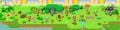 World 1 - Grassland world
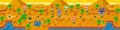 World 2 - Desert world
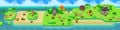 World 3 - Island/Ocean world
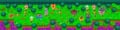 World 4 - Forest world
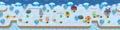 World 5 - Ice world
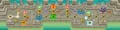 World 6 - Rock world
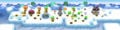 World 7 - Sky world
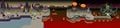 World 8 - Haunted/Volcano world


Super Mario Galaxy[edit]

In Super Mario Galaxy, the Mushroom Kingdom appears at the beginning during the Star Festival before being attacked by Bowser, who abducts Peach, along with her castle. It appears again in Grand Finale Galaxy and its only mission, The Star Festival.
New Super Mario Bros. Wii[edit]

New Super Mario Bros. Wii retains the Mushroom Kingdom as the game's main location, and shares the same world themes as the previous game, albeit with Worlds 3 to 5 in swapped order.
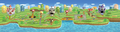 World 1 - Princess Peach's Kingdom
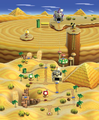 World 2 - Desert World
 World 3 - Frozen World
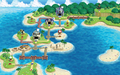 World 4 - Water World
 World 5 - Jungle World
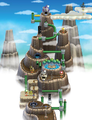 World 6 - Rock World
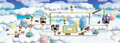 World 7 - Cloud World
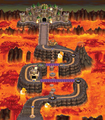 World 8 - Bowser's World


Super Mario Galaxy 2[edit]

In Super Mario Galaxy 2, the Mushroom Kingdom appears at the beginning; however, it can only be visited once. It serves as the first area of the game and is where Mario meets Baby Luma and discovers Bowser's new plan to rule the universe.
Super Mario 3D Land[edit]

The Mushroom Kingdom returns as the main setting of Super Mario 3D Land. Peach's Castle is seen at the beginning and end of the game, as well as in the background of World 1-1.
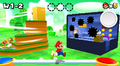 World 1 - Grassland world
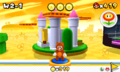 World 2 - Yellow plains world
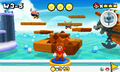 World 3 - Pale blue meadow
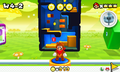 World 4 - Mushroom forest world
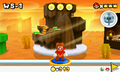 World 5 - Canyon and mountain world
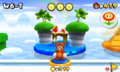 World 6 - Cloud world
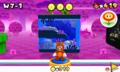 World 7 - Dark forest world
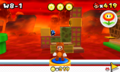 World 8 - Volcano world


New Super Mario Bros. 2[edit]
New Super Mario Bros. 2 still takes place in the Mushroom Kingdom and has fewer worlds than previous games; however, some world themes are merged to accommodate.
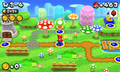 World 1 - Grassland world
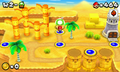 World 2 - Desert world
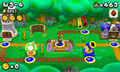 World 3 - Beach/forest world
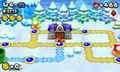 World 4 - Snow world
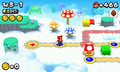 World 5 - Sky/mountain world
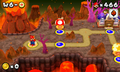 World 6 - Volcano world


New Super Mario Bros. U / New Super Luigi U / New Super Mario Bros. U Deluxe[edit]
In New Super Mario Bros. U, Bowser attacks Peach's Castle and uses the Mecha Hand to toss Mario, Luigi, Yellow Toad, and Blue Toad from the castle to the Acorn Plains, noted to be one of the furthest locations in the Mushroom Kingdom.[1] Thus, where most Super Mario games have the player start near Peach's Castle then go to Bowser's Castle, this game has the player or players start from a far off location in the Mushroom Kingdom and return to Peach's Castle. Unlike previous installments in the New Super Mario Bros. series, in New Super Mario Bros. U and its port for the Nintendo Switch, the worlds of the Mushroom Kingdom have names. New Super Luigi U has all of the same worlds, but Mario is not a part of the story. Instead, Nabbit joins the player characters after they land at Acorn Plains.
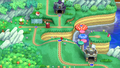 World 1 - Acorn Plains
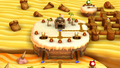 World 2 - Layer-Cake Desert
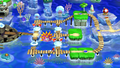 World 3 - Sparkling Waters
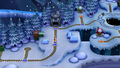 World 4 - Frosted Glacier
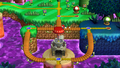 World 5 - Soda Jungle
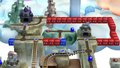 World 6 - Rock-Candy Mines
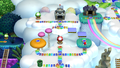 World 7 - Meringue Clouds


